Showing posts with label health. Show all posts

Tuesday, January 08, 2008

Infants With Colic

First, lets set one thing straight. ALL BABIES CRY. Some cry alot. Crying is healthy and is one of the main ways that our newborns communicate. But some babies cry more than others do. And some, although they're healthy, well-fed and well cared for, seem to cry inconsolably for hours at a time. If your baby cries about the same time each day and nothing you do seems to comfort him or her, your baby may have colic. First things first. . . DON'T PANIC! Colic is not dangerous and it is not permanent. "Not permanent" means temporary, as in, it WILL go away. You will regain your sanity and you ARE NOT a bad parent. Despite our best efforts, about two in ten infants will suffer from a bout with colic so you are certainly not alone. But, if you have come to this blog for information and guidance, chances are you are feeling pretty desperate at this point. Read on.

What is colic? Basically Colic is a pattern of excessive crying with no readily apparent cause. (No kidding!) Of course, that sounds more like a description of the symptoms and less like a definition of the problem. Traditionally, colic has been ascribed to abdominal pain resulting from trapped gas in the digestive tract. This theory is not yet discredited, and some recent scientific evidence seems to support it, yet it is no longer universally accepted as the general cause.

Some folks attribute colic to dietary factors. But, even breastfed babies can suffer from colic. Which implies that the culprit is not purely dietary. One of the most accepted theories is that colic results from a combination of a baby's sensitive temperament, their environment, and a still immature nervous system. These factors combined create a propensity for them to cry easily no matter what the disturbance. The bottom line is: no expert has an answer for what colic really is.

Another point to take some comfort from is that, though your baby may look very uncomfortable, colic is usually not thought to be very painful. Babies with colic are healthy babies. It is not a medical problem per se and it is not indicative of problems in the way that the baby is being handled or treated. In other words, it is not your fault. However, it is in our nature as parents to take steps to eliminate anything that brings our little one to tears. So, if your baby is crying incessantly, you should make sure to consider other possible reasons (e.g. hunger, tiredness, being startled, temperature, diaper rash, etc.) before concluding that they are indeed colicky.

Since the cause of colic is so poorly understood, there is no singular method of treating or relieving it. Some parents have found the following to be helpful in soothing a colicky baby:

Try "babywearing"
Wrap the baby snugly in a blanket (this is called swaddling)
Keep the baby moving in a baby swing
Put them near continuous noise or vibrations from household appliances like the dishwasher, vacuum cleaner or washer-dryer
Take him or her for a car ride or a walk outside
Give them tummy or back rubs
Take a shower with them - the warm water may be comforting

The following links point to some excellent reading on the topic of colic.

http://www.lpch.org/HealthLibrary/ParentCareTopics/NewbornQuestions/CryingBabyLessThan3MonthsOldIncludesColic.html

http://www.kidshealth.org/parent/pregnancy_newborn/common/colic.html

http://familydoctor.org/036.xml

Research as you might, there is no reasoning with a colicky baby. One last piece of advice. . . Try to stay calm and get some rest. Colic is harder on the parent many times than it is on the baby. The continuous crying of your baby will likely lead you to feel stressed and frustrated. Your nervousness can actually exasperate the problem. Your baby is very sensitive to your mood and may pick up your nervousness leading the baby to even more crying.

Take time for yourself and seek out some support. If you start feeling overwhelmed, ask a partner or friend to take over for a while, even if only for an hour or two.

If you have experience to share on the topic of colic, please take a moment to share it with us in a comment.

Monday, December 31, 2007

Baby Heart Monitors

At first we were so excited about the prospect of being able to hear the heartbeat of our unborn child. Like many new "parents to be" our enthusiasm exceeded our patience to research and we spied a convenient "solution" at a maternity clothing store. We ended up investing over $50 for our prenatal heart monitor thinking we would be able to enjoy listening to the sound of our child's heartbeat. The first time we used it we could not hear a thing. Well, actually you could hear alot! But, none of the crackling, swooshing sounds were remotely what we expected. We blamed it on ourselves thinking that we may be using it wrong. We reread the directions to find out what the problem could be. "Why can't we hear the heartbeat" we thought. The manual stated that the baby would have to be further along, about 5-6 months before we would be able to hear her actual heartbeat. We thought that a bit odd since we had already heard her little heartbeat so clearly at the doctors office.
Each night we waited with anticipation to hear her heartbeat and no matter how far along my wife got, there was nothing "babylike" to be heard. During one of our visits to the doctor, I mentioned this to him and he stated that only "Doppler" based listening devices would be able to accurately pick up the baby's heart sounds.

That was an eye opener. These Doppler devices are not cheap and you will not find them at malls or maternity clothing stores. If you are interested in buying or renting one, you might try here:

Stork Radio
Baby Beat

I thought to myself "Then how could a company get away with selling a monitor that supposedly picks up the baby's heartbeat?"

Well, our doctor ended up being correct. We never did actually manage to hear Olivia's heartbeat. Right up until the night before she was born, there was nothing but a very random "swooshing" noise coming from the monitor. I will say this though, the item we bought came with a connection that was actually a speaker. Erin would attach the speaker and lay it on her belly each night as she read to the baby. It was apparent that these little speakers actually worked because the first time I ever read to Olivia, she responded immediately because of the change in voice. You see, Erin had been reading to her for months each night. I decided that I wanted to get in on the action. When I started reading, Erin immediately exclaimed that the baby was moving in a way she never had before! We came to the realization that this things value was not in hearing the baby's heartbeat. We were communicating with our child in a more effective way. She could actually hear us! What an amazing experience.

So if you are wondering how effective the typical "store bought" heart monitors can be, we can tell you from experience that personally we feel that they don't really work very well at all. But if you are yearning for your baby to hear your voice more clearly, then our suggestion is to get one of those devices that actually allows you to beam beautiful vocal waves more efficiently into the womb so you can tell your child how much you love them and can't wait to meet them! And of course, savor the opportunity you get to hear your babies heartbeat at the doctor's office.

Here are a few more opinions you might want to consider:

Prenatal Monitor Reviews

Thursday, November 08, 2007

November 8, Daily Poop

Today's Quote: Having a family is like having a bowling alley installed in your brain. ~ Martin Mull

Did you know?: Overweight children are up to 5 times more likely to have a heart attack or stroke before the age of 65. So if your're overfeeding your 'little' one, you could be killing them with kindness.

Friday, November 03, 2006

November 3, Daily Poop

Today's Quote: If evolution really works, how come mothers only have two hands? ~ Milton Berle

Did you know?: A woman’s odds of having quadruplets are about one in 600,000.

RECALL ALERT

The U.S. Consumer Product Safety Commission has announced a voluntary recall of the following consumer product(s). You should stop using recalled products immediately unless otherwise instructed.

Product Description: “Shake ‘n Jingle Keys,” “Shake & Jingle Keys,” “My Jingle Keys” all by The First Years and the John Deere “Real Keys” are toy keys, with three colored keys attached to a blue, red or green remote control with electronic features. Various colored buttons on the remote activate sounds. Only toy keys with the letter “F” in the date code stamp listed between date codes 2015F01 through 2636F04 on the packaging and product are involved in the recall. The date code can be found on the back of the remote control. Toy keys with “TE” in the date code or yellow sides on the remote are not included in this recall.

See full information related to this recall at: http://www.cpsc.gov/cpscpub/prerel/prhtml07/07023.html


Product Description: The units involved are flashing pacifiers and flashing pacifiers with whistles. The pacifiers are clear or colored purple, blue, pink or green. The pacifiers have five flashing LED lights that are red and blue, red and light green and orange. Some pacifiers are sold with a rainbow cord that is attached to handles, and some cords have breakaway connectors. One pacifier has multi-colored beads on the cords in the shapes of barrels, trains, boats and various animals. Pacifiers were sold in clamshell packages. The packaging has a warning that states they are for “12+ Years” or “6+ Years.” Some of the products have a warning on the packaging that they are not a real pacifier, but a practical joke.

See full information related to this recall at: http://www.cpsc.gov/cpscpub/prerel/prhtml07/07024.html

Thursday, November 02, 2006

Cribs That Can Kill

There is something special about receiving and using a family heirloom in raising your own little one. Erin and I both treasure the very idea of using special items or articles of clothing that have been handed down to us from passed generations. But not all "hand me downs" are created equal. Old cribs can kill.
Your baby's crib should be a place of safety and comfort; a haven in which they can rest and sleep in peace. You would certainly never intentionally place your precious baby in a dangerous environment. Yet, the Consumer Product Safety Commission has identified old and used cribs as their "Most Wanted" when it comes to hazardous infant and toddler products. Why?

The CPSC reports that more than one child dies every week in a dangerous crib. In addition, thousands of babies require treatment in hospital emergency rooms each year because of injuries sustained from an old or improperly manufactured crib. The fact is, more infants die every year from cribs than from any other nursery product.

For new parents, those are some pretty startling, even terrifying, statistics. So what can you as a parent look for to insure that any used, or even newly manufactured, crib is as safe as it should be? The CPSC has determined that the following factors are vital to insure that your child's crib is up to appropriate safety standards:

For wooden cribs there should be:

1) A firm, tight-fitting mattress so baby can't get trapped between the mattress and the crib. You should not be able to fit more than two fingers in the space between the mattress and the crib. In addition, any plastic covering on the mattress must be removed before it is used.

2) No missing, loose, broken or improperly installed screws, brackets, or other hardware on the crib or mattress support. Remember to check the crib's hardware periodically. A physically active child can cause the hardware to loosen, making the crib more prone to collapse.

3) No more than 2 3/8 inches (about the width of a soda can) between the crib slats so a baby's body can't fit through the slats; no missing or cracked slats.

4) No corner posts over 1/16th of an inch high so a baby's clothing can't catch. Babies have strangled when their clothing snagged on these posts.

5) No cutouts in the headboard or foot board so a baby's head, arms, or hands can't get trapped.

For mesh-sided cribs and playpens, look for:

1) Mesh less than ¼ inch in size, smaller than the tiny buttons on your baby's clothing.

2) Mesh with no tears, holes or loose threads that could entangle your baby.

3) Mesh securely attached to the top rail and floor plate.

4) Top rail cover with no tears or holes.

5) If staples are used, they are not missing, loose or exposed.

Erin and I want to make Olivia's environment as safe as possible. All parents do. There are so many ssurprises and unforeseen risks that arise that we as parents are always "on guard" and a little stressed. The baby's crib should not be one of those worries. Attention to the guidance provided should help eliminate some of that stress.

There are other situations and items in the nursery that need to be scrutinized if we are to keep baby safe. Stay tuned, as will discuss some of these in a future article.

The following is a list of links pointing to some of the most recent baby crib recalls. Take a moment to insure that you are not currently using a dangerous crib with your precious little one. Of course, we will be forwarding any future recalls that we become aware of as our blog progresses.

CPSC, Simplicity Inc. Announce Recall of Graco Branded Aspen Cribs for Suffocation Risk (Dec. 21, 2005)
CPSC, Delta Enterprise Corp. Announce Recall of Certain Cribs Sold at Toys R Us Stores (Nov. 22, 2005)
CPSC, Child Craft Industries, Inc. Announce Recall of Cribs (Oct. 18, 2005)CPSC, Pottery Barn Kids Announce Recall of Spindle Cribs (Sept. 8, 2005) CPSC, Simplicity Inc. Announces Recall of Cribs (May 3, 2005)
CPSC, Delta Enterprise Corp. Announce Recall to Repair Portable Cribs (March 9, 2005)
CPSC, Orbelle Trade Inc. Announce Recall of Cribs (Jan. 6, 2005)
CPSC, Stanley Furniture Company Inc. Announce Recall of Cribs (March 24, 2004)
CPSC, Child Craft Indutriess Announce Recall of Cribs (Feb. 24, 2004)
CPSC, Babi Italia/LaJobi Industries Announce Recall to Replace "Tiffany" and "Josephine" Crib Drop-Side Rails (June 4, 2003)
CPSC, Baby's Dream Furniture Inc. Announce Recall to Repair Cribs (May 15, 2003)
CPSC, Hufco-Delaware Company and Evenflo Company Inc. Announce Recall to Repair Gerry® and Evenflo® Portable Wood Cribs (Jan. 23, 2003)
CPSC, Vermont Precision Woodworks Announce Recall of Cribs (April 25, 2002)
CPSC, Fisher-Price Announce Recall of Portable Bassinets (July 31, 2001)
"Le Cradle" Bassinets Recalled by Kids Line (August 23, 2000)
Swings & Domes Recalled by Fisher-Price (April 7, 2000)
Cribs Recall/Repair by Simmons (February 21, 2001)
Pisces Baby Cribs Recall by Generation 2 Worldwide (May 10, 1999)

Monday, October 30, 2006

Making the Decision to Breastfeed

Making the choice to breastfeed was one of the easiest decisions I have ever made. I was very proud and optimistic about my choice. But I was actually shocked at the reception my decision got from friends and family. First off, I quickly found out that I would be the first person in my family to ever choose to breastfeed. My friends thought I was insane to take on such a "daunting" task, even teasing that I was doing it only to "save money on formula". But I was determined since I knew it was the best decision for me and my baby. I also knew that this was a huge undertaking, one that could not be taken lightly. I started to gather information immediately. I read everything I could get my hands on until I felt informed and prepared. Ironically, at times, it seemed the more I read the more nervous and anxious I got about this very important decision.

Randy and I decided it would be best to do research together. We both felt that the support from one another would make this a committment we could both handle and be proud of. It was kind of funny though, when I registered us for a breastfeeding class, Randy's first thought was "Do I really need to go?" But to our surprise it was so informative for us both that we found even though I would be doing the actual feeding, we both had very important roles.

With great appreciation, I found that Randy was also doing research on his own about breastfeeding. We started sharing our research with each other. I felt equipped to handle this commitment long before Olivia was born. Taking a class and reading as much as you can about the facts of nursing your baby are a surefire way to stick to your commitment to breastfeed.

But a word of caution. A short time into my days of reading about breastfeeding, I found that I was becoming more and more anxious. I kept reading stories in parenting and pregnancy magazines about moms who tried nursing and the struggles they went through. While a small amount of this was healthy for me to get a good idea of what I would be facing, after a while the negativity some moms had started to weigh upon my mind. I even remember a girlfriend of mine, who had just had her own baby, telling me that her lactation consultant in the hospital was mean and made comments about the fact that formula fed babies are always sick. I thought to myself, "My goodness, how rude". But after speaking with Randy about the things I was reading he helped me put things in perspective. Each person will have their own experiences and perceive things differently. It is up to you to make the choice and do what is best for you and your baby. No one, and I mean no one (not even your mother or mother-in-law), can tell you what to do when it comes to breastfeeding (or not breastfeeding) your baby.

That being said, I love nursing Olivia. It has been one of the best experiences of my life. But looking back on making the decision, both Randy and I know that we could not have done this had we not prepared for it right from the start. And I can't help but understand why most people either don't try it or don't stick with it after they do. A well informed and committed person can make it through anything.

Some excellent Web resources on breastfeeding are:

www.lansinoh.com

http://www.fda.gov/fdac/reprints/breastfed.html#tips

http://www.parenting.com/parenting/article/0,19840,1039847,00.html

http://www.lalecheleague.org/FAQ/faq.html

There is so much involved in breastfeeding that I did not cover all the issues that go along with it. Stay tuned, in future posts I will discuss concerns and suggestions based on my experiences in breastfeeding.

Friday, October 27, 2006

CAUTION! - Recall Alert

Like you, Erin and I would like to consider ourselves relatively savvy shoppers. We usually try to do at least some research on any item before we take the leap and make a purchase. This is especially true when it comes to things we purchase for our daughter, Olivia. Like most parents, we have adopted the philosophy: "You can't be too careful". But, we still like to know when manufacturers recall their products just in case, despite our diligence, we happen to have the misfortune of selecting a product that turns out to present a hazard.

What is a recall? Wikipedia defines a recall as, "a request to return to the maker a batch or an entire production run of a product, usually due to the discovery of safety issues. The recall is an effort to limit liability for corporate negligence (which can cause costly legal penalties) and to improve or avoid damage to publicity. Recalls are costly to a company because they often entail replacing the recalled product or paying for damages caused in use, albeit possibly less costly than indirect cost following damages to brand name and reduced trust in the manufacturer."

Usually, a U.S. regulatory organization known as the CPSC will enforce and announce the recall of products that present a significant risk to consumers either because the product may be defective or violates a mandatory standard issued by CPSC.

What is the CPSC? The Consumer Protection Safety Commission is a Federal regulatory agency that works to reduce the risk of injuries and deaths from consumer products. There are a few ways they seek to accomplish this. One is by developing voluntary standards in cooperation with industry regarding the safe manufacturing of products. In addition to this they issue and enforce mandatory standards that are established by the government. They also ban consumer products if no feasible standard would adequately protect the public. Other ways the CPSC serves the public interest is by conducting research on potential product hazards; informing and educating consumers through the media, State and local governments, private organizations, and by responding to consumer inquiries.

We encourage you to check the current recalls issued by the CPSC yourself by pointing your browser to: http://www.cpsc.gov/cpscpub/prerel/prerel.html

For the benefit of ourselves, and our readers, we have already examined the last few months worth of recalls and selected those that seemed most pertinent to new parents. The following list contains the recalls issued by the CPSC in the months of August, September, and October of 2006. Check the list to see if you identify anything of concern to you.

LeapFrog Recalls to Repair Children’s Activity Centers Due to Arm Entrapment Hazard
In cooperation with the U.S. Consumer Product Safety Commission (CPSC), LeapFrog Enterprises Inc., of Emeryville, Calif., is voluntarily recalling about 186,000 Playground Activity Centers. A child’s arm can become caught in the activity center’s plastic tube, posing a risk of injury to children.

Playskool Voluntarily Recalls Toy Tool Benches after the Death of Two Toddlers
In cooperation with the U.S. Consumer Product Safety Commission (CPSC), Playskool, of Pawtucket, R.I., is voluntarily recalling about 255,000 Team Talkin’ Tool Bench toys following the deaths of two young children. Playskool received reports that a 19-month-old boy from Martinsburg, W.V., and a 2-year-old boy from League City, Texas, suffocated when oversized, plastic toy nails sold with the tool bench toys became forcefully lodged in their throats.

Suave Kids Bath Sets Sold at Wal-Mart Recalled for Choking, Other Hazards
In cooperation with the U.S. Consumer Product Safety Commission (CPSC), Almar Sales Co., of New York, NY, is voluntarily recalling about 11,000 Suave Kids Bath Sets. Items in the baths sets contain small parts that pose a choking hazard to young children. Additionally, some of the handles on the carrying case are long enough to pose a strangulation hazard. Also, the plastic carrying case poses a danger of suffocation.

Baby Cookie Monster Toys Sold with DVD at Wal-Mart Recalled for Choking Hazard
In cooperation with the U.S. Consumer Product Safety Commission (CPSC), The Betesh Group of New York, NY, is voluntarily recalling 31,000 Baby Cookie Monster Plush Toys. The small felt fabric cookie attached to the plush toy’s hand can be removed easily and ingested by young children, posing a choking hazard.

Scandinavian Child Recalls Cariboo™ Baby Changing Tables Due to Fall Hazard
In cooperation with the U.S. Consumer Product Safety Commission (CPSC), Scandinavian Child, of Raleigh, N.C., is voluntarily recalling about 90 Cariboo™ Folding Changing Tables and 40 Cariboo™ Bassinet Changers. If the zipper is misaligned, it can come apart and allow the cloth surface to separate, posing a fall hazard to the baby.

LEGO Recalls Toy Trucks Due to Puncture Hazard to Young Children
In cooperation with the U.S. Consumer Product Safety Commission (CPSC), LEGO Systems Inc., of Enfield, Conn., is voluntarily recalling about 358,000 LEGO EXPLORE Super Trucks. The plastic wheels on the truck can detach, exposing a metal axle. This poses a puncture hazard to young children.

Erin and I have subscribed to the CPSC mailing list and anticipate receiving email alerts any time a new recall is issued for any baby related merchandise. You could do the same when you visit their website. As an alternative, be sure to check back here at "Babies On The Net" since we will surely post any recalls we become aware of for your benefit.

Saturday, October 21, 2006

What is Coxsackie?

At least once, probably several times, in the first months or year of your baby's development, you will receive a call that sounds something like this. “Bob and I just wanted to call and apologize. We are really, really sorry. You see we just took Junior to the pediatrician and he has Chicken Pox. We wanted to let you know since your baby and ours were together the other day and…” Such a call can be alarming, since it indicates that, unbeknown to you and despite your best efforts to avoid it, your baby was exposed to something contagious. Now you will have to do your research and begin watching for symptoms. If you are like Erin and I you may even get a little paranoid as you suddenly start interpreting otherwise normal behavior as symptoms.

It is bad enough to become aware that your baby may be facing a bout with a well known contagion like Chicken Pox. But, it is quite a different matter if the dreaded call announces that your baby has been exposed to something you have never heard of. This happened to us just the other day and we were petrified to find that our baby was at risk for contracting “Coxsackie”. Oh no, not Coxsackie!? Wait a second, I have never heard of it. You sure it isn’t Pox Sackie, or Sackie Pox? In any event, it certainly sounds dangerous! Who names these childhood diseases anyway? Actually, this disease is more commonly referred to as “Hand-foot-and-mouth Disease”, which is no less bothersome than to say Coxsackie. We fired up Google, determined to find out as much as we could about this mystery ailment. Here is the scoop:

What is Coxsackie? Coxsackie is a collection of closely related viruses that was first isolated and identified in 1948 in a small river town in New York State, USA named, ironically, Coxsackie. (Thus it's exotic sounding moniker.) Coxsackie is very contagious and, though babies and young children are most at risk, anyone can contract it. This virus belongs to a family called enteroviruses. This is a fancy word for a microscopic invader that enters and then sets up shop in the body through the gastrointestinal tract. Other enteroviruses include poliovirus and echovirus. These viruses have the ability over time to mutate into other forms or strains, which is why they reemerge every so often resulting in outbreaks among populations that have not established any form of immunity to them. In the case of Coxsackie, the mutation can be relatively slow and therefore it appears to produce a new strain, or “model”, every two to five years. Scientists refer to this natural phenomenon as “genetic drift”.

The Coxsackie virus, like most other viruses, does its damage by confusing the body’s antigen recognition system and defense mechanisms. Specifically, the body reacts to the virus' presence by sending out specially programmed antibodies that act like little virus-seeking missiles to destroy it. This is usually a good thing and in most cases the infection is contained and limited in its scope. The problem lies in the fact that the Coxsackie virus is capable of mimicking the protein structure of certain vital tissues in the body including the heart muscle. So in some cases the little virus-seeking missles can wind up attacking not just the virus, but also the vital body tissues that have become it's unfortunate host.

What are the symptoms that your baby may have contracted Coxsackie? The symptoms include flu like symptoms including fever, head and muscle aches and perhaps a rash. A mild sore throat is usual, accompanied sometimes by nausea or abdominal pain. Some children will show only very mild or no symptoms at all if they are infected by Coxsackie. In many cases, it is brushed off as being a non-specific runny nose. So you may only suspect based on a parents "intuition".

Some children develop small painful blisters in their mouth, on the tongue and inside their cheeks, as well as on the palms and soles of the feet. There may be painful blisters or ulcers in the back of the throat known as herpangia. These would be located on the tonsils and the soft fleshy part on the roof of the mouth. Some victims may develop chest pain when breathing.

Some symptoms may indicate that your baby has come into contact with one of the more aggressive forms of the virus. If your baby exhibits any of the following symptoms, medical help should be sought as soon as possible: fever, difficulty feeding, low appetite, vomiting, diarrhea, convulsions, difficulty breathing, sleeplessness, red swollen watery eyes, sores inside the mouth or on the skin, or severe muscle pain in the chest or abdomen.

What can I do if I think my baby has Coxsackie? It is advisable to take your little one to a pediatrician if any combination of these symptoms occur. Even if you suspect that your child has contracted a mild strain of the virus, it is best to have your doctor examine them to exclude other, more dangerous, conditions which may produce similar symptoms.

Most children recover completely from Coxsackie after a few days of rest. The most effective treatment includes rest, plenty of fluids, and any action which eases the painful symptoms of the illness. However, your doctor may suggest other things as well. Unfortunatly, there is no vaccine or antibiotic that is effective against viruses. So you will be faced with waiting anxiously, keeping your child as comfortable as possible, as the virus runs it's course and your child's body progresses to recuperation. During this period, it is important to keep your baby away from other children. A baby with Coxsackie is most contagious during the first week that they are sick.

You will find some other suggested treatments or "comfort tools" in the recommended reading list below.

What is the best way to prevent my baby from contracting Coxsackie? Enteroviruses are very hardy and stubborn. They can survive for several days outside the human body, even in frozen outdoor conditions. They are spread through contact with saliva, mucous, or the feces of another infected individual. Diligence in hand washing and good hygiene are the best forms of prevention. Careful handwashing after changing diapers and before preparing food can help stop the spread.

Where can I found out more about Coxsackie?

http://www.kidshealth.org/parent/infections/bacterial_viral/coxsackie.html

http://www.askdrsears.com/html/8/T082600.asp

http://www.medic8.com/healthguide/articles/coxsackie.html

For some fascinating reading on viruses, check out this site:

http://library.thinkquest.org/23054/basics/index.html

Friday, October 13, 2006

How Well Can New Babies See?

"Look Dear, she is looking at me!"... "It must be that pink blouse. That seems to be her favorite color." The days after the birth of a newborn are generally filled with comments similar to these. We intuitively know by watching the babies reactions, or lack of reactions, that our baby's eyesight is not completely clear. Some bystanders will chime in, "Come on! Seriously... The baby's vision is blurred until they are six months old." This has been the conventional wisdom for many years based partly on a general lack of guidance from the medical experts. To a great extent, the majority of folks still subscribe to the opinion of William James, the great 19th century philosopher and psychologist, who argued that an infant's visual world amounted to a "booming, buzzing, confusion." But, we want to interact and bond with baby. So we hope and wonder how well our little one can see our faces and the wonderful profusion of colorful baubles that we surround them with. I will admit, you could not have convinced me that Olivia wasn't transfixed by my face when I softly spoke her name.

So what can an infant see? The answer to this question lies in the answer to two other related questions. 1) How far can the baby see? and 2) How clearly can the baby see? I did some research on these two questions and though there are a lot of varying opinions, even amongst experts, there is a general consensus that provides a reasonable response.

Let's consider the first question. How far can my baby see?

Generally, experts agree that newborns are short-sighted. They are pretty good at following the movement of highly contrasting objects that are no more than 7-12" away. Actually, their little eyes have all of the functionality and optical parts needed to focus perfectly on objects at any distance. However, the ability to control their focus is still in development. Let me explain.

The eye is able to focus on an image because tiny muscles called ciliary muscles change the eyes shape making it longer or shorter as needed. A good analogy is the way a camera lens lengthens or shortens to convey a sharply focused image onto film when we take a picture. An infant's eyes are perfectly capable as a lens at birth. It is the coordination of these ciliary muscles that is still in need of refining. Since these muscles are still developing and lacking a bit in coordination, the baby's eyes may either focus too close (in front of an object) or too far (behind an object). Now for the next question.

How clearly can the baby see?

We have already discussed that focusing, and more importantly accurately focusing, can be a challenge for young babies. The other factor that determines how clearly the baby will see is how well the brain processes the image. This is referred to as acuity. Images that pass into the eye are projected on the retina. The retina is a thin layer of neural cells that line the back of the eyeball. The retina is still incompletely developed in infants. For this reason, even though the optic components of the eyeball itself are capable of producing images in sharp focus onto it's surface, the retina and the neural pathways that are used to carry the images are immature and do not convey a clear image to the brain. This limits how clearly an infant can resolve the images the eye receives.

So how fuzzy is an infants vision? Most experts agree that in the first month of life, a baby can achieve visual acuity of about 20/120. In simpler terms, if babies could read, they would be able to read the big "E" at the top of a standard eye chart. Fortunately, this situation quickly improves. By 4 months of age, acuity has improved to 20/60 and by 8 months the babies nervous system has matured enough to improve acuity to 20/30.

So what's the bottom line? Babies have a real challenge in their early months focusing on objects. Especially those that are not viewed up close. However, a newborn infant can easily see many of the things that are most important to them and you. Hold them close in your arms and they will certainly be able to make out your eyes, lips and nose. They will also be fascinated by their own hands, fingers, feet and toes. And come to think of it, those are the very things we will be focusing on also.

Finally, what can I do to promote proper development of my baby's vision?

Check out the following links for facts about your infant's vision as well as things you can do to insure your baby has the appropriate level of visual stimulation:


http://www.ski.org/Vision/babyvision.html?id=10


http://www.webmd.com/content/Article/119/113496.htm


http://www.allaboutvision.com/parents/infants.htm

You probably have seen those black and white mobiles and toys that are being touted as "visually stimulating" to your baby. Are these items really more beneficial than other designs? We will discuss what we found in another post. So stay tuned.

Tuesday, October 10, 2006

Caffeine And Breastfeeding

Lately Olivia has been really fussy around bed time. Erin also noted that Olivia was not napping as she usually did throughout the day and that she was crying more and more for no apparent reason. This set us to wondering, since she usually slips into dreamland without too much fuss or bother. Erin suggested that Olivia's fussiness might relate to her own recent decline in caffeine consumption. She wondered if our daughter was showing the irritability that you would expect of an adult that was suddenly "detoxing" from caffeine. Could it be true? Could the caffeine Erin was consuming actually be passing through into her breast milk? And if so how much of it was passed on and what affect might it have on Olivia?

We set off to do some research to find the answers to these questions. What we discovered was enlightening. It set the tone for our approach to all things consumed while my wife was breastfeeding. Here is what we found:

The amount of caffeine in five or fewer five-ounce cups of coffee will not typically cause a problem for most mothers and babies. In "Breastfeeding: A Guide For the Medical Profession", by Ruth A. Lawrence, M.D. and Robert M. Lawrence, M.D., the authors write:
"Caffeine ingestion has been singled out for discussion because it is a frequent concern, but the data provided in most reviews are misleading. With a given dose of caffeine that is comparable to that in a cup of coffee, the level in the milk is low (1% of the level in mother) , and the level in the infant's plasma is also low. However, caffeine does accumulate in the infant."

This would tend to indicate that moderate consumption of caffeine would not be a source of worry. However, other resources we found on the web (listed below) confirmed that babies may be more nervous and irritable, feed more frequently, and have sleep problems if the mother ingests a lot of caffeine while breastfeeding. This is because a baby's system is not as efficient as an adult's at ridding itself of caffeine, so it can build up and it's effect can be cumulative. Most of the enzymes that metabolize caffeine are not present in the livers of newborn babies. Because of this, all of the caffeine in their blood has to be excreted through the urine, which is a slow process.

Based on what we found, it is very unlikely that Olivia is experiencing true caffeine withdrawel jitters. But Erin does feel that based on the amount of caffeine she was accustomed to consuming, she and Olivia would both benefit from her cutting back. If you are concerned about the amount of caffeine you are consuming or it's effects on your baby, you should consider cutting back also. Remember, caffeine can be found in soft drinks, and some herbal teas and medications, in addition to coffee and tea. Chocolate contains theobromine which can act like caffeine in both the mother's and baby's systems. Also, keep in mind that if you do drink caffeine, it is important to remain well hydrated by drinking plenty of water and juices.

Want to do some further reading on this topic? Here are some links to consider:

http://www.aap.org/pubed/ZZZNIUQXQ7C.htm?&sub_cat=1

http://parenting.ivillage.com/newborn/nbreastfeed/0,,40tg,00.html

http://www.babycenter.com/refcap/baby/postpartumnutrition/4488.html

What else can pass to our babies through breast milk? Stay tuned. We pondered the same question and will share our research with you in future post.

Friday, October 06, 2006

What Is "Babywearing"?

The baby is finally home. The doctor's have all signed off, the relatives have gradually dwindled away home, and now it is just you and baby. There she lays. Waiting. Juuuusssst waiting. Waiting for what? To be picked up and carried to the mall of course. Okay, maybe it is to the supermarket, or the park. But, this simple reality can create a real dilemma for new parents. The baby has some pretty convenient handles by which to pick it up. But, carrying baby around for more than 20 or 30 minutes can be tiring and tedious. Strollers are great, but they can be tough to maneuver in tight or uneven areas. So how do you bring baby along wherever you are going without wearing yourself out? One very popular solution is referred to as "babywearing". What is it?

Babywearing is the act of wearing or carrying a baby or child in a sling or other form of carrier. Babywearing is far from new and has been practised for many years around the world by a wide spectrum of cultures. In the industrialized world babywearing has gained popularity, partly under influence of advocates of attachment parenting. Babywearing has become a popular and chic form of baby transport.

There are a lot of advantages to babywearing. Notice what La Leche League International says about babywearing in an article entitled "The Benefits Of Baby Wearing". This report impressed me as thorough and it made a lot of sense.

We asked a friend of ours that runs a small business creating baby sling carriers, why sling carriers have become so popular. She replied, "Wearing your baby in a sling promotes bonding between the baby and you. Babies are more comfortable when being held and are calmer. Having your baby in a sling versus a stroller allows your baby to see the world with you, and allows you to travel easier without the hassle of a bulky stroller. Your baby can sleep, nurse, be bottle fed, or just relax in the safety of a sling baby carrier." When I told Erin I was researching this topic, she informed me that she had learned from her own reading that babies that are "worn" actually develop more self-confidence and tend to be more independent and outgoing than babies who are relegated to strollers.

Want to do more research on babywearing? A good place to continue learning on the topic is at www.thebabywearer.com. Obviously, there are a lot of alternative methods of keeping baby close and involved while you carry on the day's activities. But clearly, babywearing has a lot of advantages.

Protecting Baby From Sun

Are you a new parent? Congratulations! So are we. Our little Olivia is just four months old and already we are astounded at how much the experience has taught us. Whoever said that "experience is the best teacher" must have had a lot of stressful moments and sleepless nights while school was in session. Of course, like you, we embrace this journey and relish each enlightening moment.

But, honestly, whenever someone takes the initiative to share a valuable tip or resource that makes raising Olivia easier or a more fulfilling experience, we really appreciate it. That is the purpose of our Blog. Sharing tips and information that we are learning from experience, found on the net, or that has been shared with us by a knowledgeable benefactor. Whether it be a better, gentler way to get baby's boogies out, or a valuable piece of info related to new products, we want to share it with you... So let's get started.

Erin, David, and I love the outdoors. We love to go picnicking, to the beach, and camping. So when Olivia was born we definitely wanted to initiate her to those kinds of activities as soon as possible. One of the things we worried about was how to keep the creepy crawlers away from our new bundle of joy. We also knew that it was important to protect her skin from the effects of overexposure to the sun. Of course, we knew we could not use any harsh sunblocks or bug repellant creams or sprays on her delicate new skin.

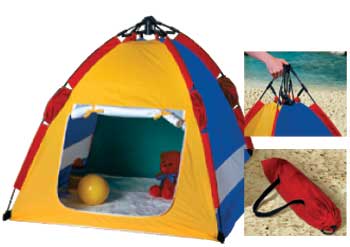
We found our solution in a product called the "Baby Cabana". The baby cabana has an SPF rating of 50+, which means Olivia's skin is well protected from the harsh effects of being out in the sun. It has openings on the sides to allow breezes to pass through and we find that it stays quite cool inside even at the beach when it is very warm and sunny. The door zips open wide to make it easy to move Olivia in or out even while still in her carrier. The cabana is so roomy that Erin has found it relatively easy to get inside it with Livi and even breast feed her while we are at the beach.

And talk about being easy to set up or take down! The entire frame is hinged and can be opened with a pull of one string. Once you are ready to go, just pull the same string while popping a couple of hinged joints and it collapses with ease and stores away in its own bag with very little effort. The Baby Cabana protects Olivia from wind, bugs, even curious pets, too! The side pockets hold sand to secure against the wind. Our cabana measures 42 1/2"H x 47W" x 47D".

How much can you expect to pay? Figure on spending between $35-$50. Where can you get your own baby cabana? Try any of the following links:

http://www.sunfriendlyproducts.com/cgi-bin/cart/items.cgi?category=Shadeproducts

http://dreamtimebaby.com/sunstopkwikc.html

http://www.safebeginnings.com/WebComponents/Catalog/Public/showproduct.asp?frg=FRG&id=423

http://www.kidsurplus.com/kelgar.html?gclid=CLak66e27YcCFRJWUAoddEM2iA

http://tinkertots.stores.yahoo.net/sunstkwcai.html

The Baby Cabana gets two thumbs up from our family. We think you will enjoy it too.

Do you have other solutions for protecting your baby from the harsh effects of sun exposure? Let us know about it in a comment.